
The Cauldron’s Social Order
Gang Up: A Bikerland NovelThis flow traces the Cauldron’s disciplined hierarchy and the tensions between its practical organization and its treatment of women.
increasing Bearing strength in each event
 decreasing
Bearing strength in each eventdecreasingDiscipline in the Camp

Order Among the Riders
Repeated practice
Brall trains his soldiers to respond to commands and move through coordinated drills. He understands discipline as essential to keeping a large, mobile group fed and directed.
A survival doctrine
For Brall, order prevents hunger and confusion from turning a force into a threat to itself. The camp’s military structure is presented as a response to the instability of life in the wastes.
The Cauldron’s discipline explains its strength, but it also establishes a chain of command that gives Brall enormous influence over others.
Women’s Assigned Labor

Efficiency and Inequality
Work organized by task
Women maintain weapons, vehicles, and structures in carefully divided roles. A worker is assigned specific tasks and expected to return to them after interruption.
Service under command
A woman may be summoned by a rider and then sent back to her work. The system values efficiency while treating her availability as part of the gang’s resources.
The labor structure reveals that the Cauldron’s apparent disorder rests on intensive organization. Its effectiveness is inseparable from a hierarchy that gives women responsibilities without equivalent authority.
The Initiation Boundary

Membership as Claim
A recognized custom
Abigail’s initiation functions as a public rite of membership. Brall understands that it will be seen as a claim by the Cauldron, whatever private purpose Abigail intended.
Consequences beyond consent
The gang’s custom gives leaders a means to define belonging, and outsiders may treat that definition as binding. The ritual therefore affects military relations as well as the initiate’s place in camp.
The episode shows how custom can be both an identity and an instrument of control. The Cauldron’s order is reinforced by practices that make membership difficult to separate from possession.
Brall Reconsiders the Code

A Leader Questions Violence
The old rule
Brall initially believes that a killing demands a killing in return. The Cauldron’s history has made continual struggle seem natural and unavoidable.
A challenge from grief
Miranda asks what further violence will accomplish, pointing to Carthage’s death. Brall cannot make the question disappear merely by repeating the code.
The moment suggests that discipline can be redirected. The same leader who commands soldiers toward war may also choose a different way to keep the gang intact.
Discipline Reassigned
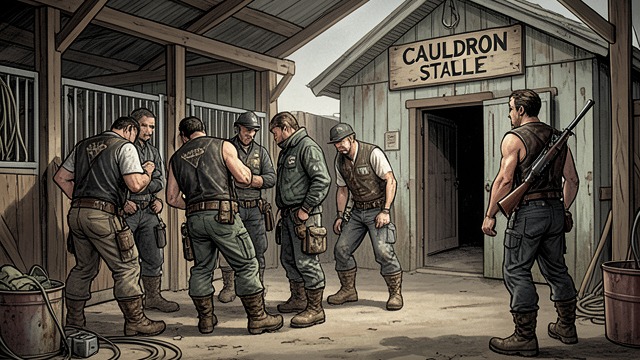
A Gang with a Home
Stable responsibilities
Under the Temple Accord, the Cauldron receives structured duties in trade and security. The arrangement offers regular work and a place to return to instead of constant movement through the wastes.
A different use of force
Brall’s soldiers retain their organization, but their discipline now supports a shared settlement. Military order becomes one component of civic life rather than only a tool of conquest.
The Cauldron does not abandon its identity. It changes what its discipline serves, revealing that social order can be redirected when its members have a practical stake in peace.
during Brall’s training day
after Abigail enters Cauldron camp
the night of Abigail’s initiation
after Carthage’s death
during the final negotiations
